In a fast-moving tech industry, the IT project manager role is still misunderstood. Plenty of companies, from startups to huge enterprises, lean on a broken idea: either the PM must be a hardcore programmer, or the PM is basically a senior admin whose job is to relay client email to engineering and paste replies back. Neither version is fair, and neither is what strong delivery needs.
In one sentence: Your worth as a PM is not “lines of code written,” and not “how fast you forwarded a chat.” The real job is to be a bridge between business problems and how the team actually ships.
So let’s be clear: that’s strategic work, not courier work. The sections below unpack the usual myths, what the “forwarder” trap looks like, and how to shift toward real integration.
The myth of the coding project manager
One myth refuses to die: you can’t lead a software project if you don’t code. That mixes up leading delivery with writing the implementation.
A solid IT PM is strong at process, integration, and communication, not at memorizing every layer of the stack. A simple rule works well: know your limits, say what you don’t know out loud, and pull in engineers who do know.
Your day job is to orchestrate: link objectives to solutions, ask the uncomfortable questions early, and turn dense technical language into something clients can act on. You’re meant to be the thinking part of the operation, not the fastest typist in the thread.
The “message forwarder” syndrome (and why it happens)
A lot of projects feel chaotic, and PMs feel stuck, when the organization never really invested in project discipline. When maturity is low, leadership quietly shrinks the PM role into a human router.
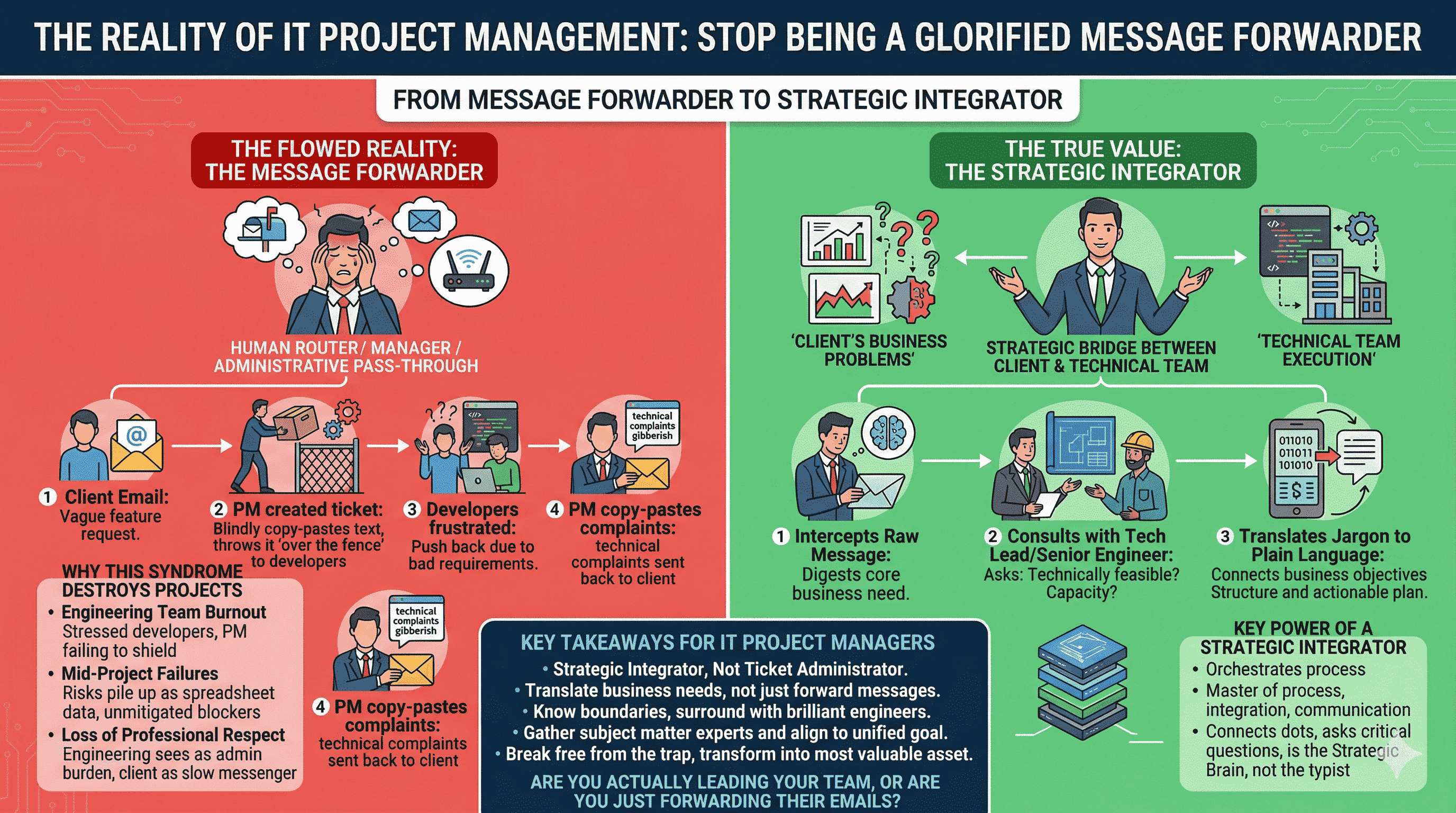
The toxic loop: maybe you’ve seen this pattern:
- The client sends a vague email about a new feature.
- The PM copy-pastes it into a ticket and sends it to dev as-is.
- Developers push back because the ask doesn’t make sense as written.
- The PM copy-pastes the technical pushback and forwards it straight back to the client.
In that loop, the PM often has no real room to analyze the request, weigh risk, or make a call. They end up feeling like a walking inbox, and everyone else feels it too.
Why that pass-through style wrecks projects
Engineering burns out. Devs get squeezed because nobody is shielding them from half-baked demands. Reverse-engineering the client’s business logic from a forwarded paragraph shouldn’t fall only on the people writing code.
Problems show up late. Without someone thinking strategically, “risks” live in a spreadsheet until they become real blockers in the middle of the sprint.
Respect drops on both sides. Engineering starts treating the PM as admin overhead, and the client sees a slow messenger instead of someone who can frame options and trade-offs.
The shift: become a strategic integrator
A strong PM doesn’t blindly forward the client’s latest ping. They intercept it.
You sit with the core business need first. You talk with a tech lead or senior engineer: Can we build this? Do we have capacity this sprint? What breaks if we say yes? Only after that do you step back to the client and the team with a clear plan, not a ping-pong chain of raw frustration.
Translation beats forwarding. Alignment beats noise.
Takeaways you can actually use
-
You’re aiming to be a strategic integrator, not a message forwarder. If your company only lets you ticket and relay, that’s worth naming out loud, and pushing back on where you need authority to clarify work before it hits the team.
-
Not knowing how to code is fine. Your leverage is getting the right experts in one conversation and steering everyone toward one business goal.
-
Breaking the forwarder habit takes courage: you take on more ownership for how work is framed. It’s uncomfortable at first, but it’s also how PMs stop being treated as paperwork and start being treated as partners.
Something to ask yourself honestly: Are you leading your team, or mostly moving other people’s emails between inboxes?